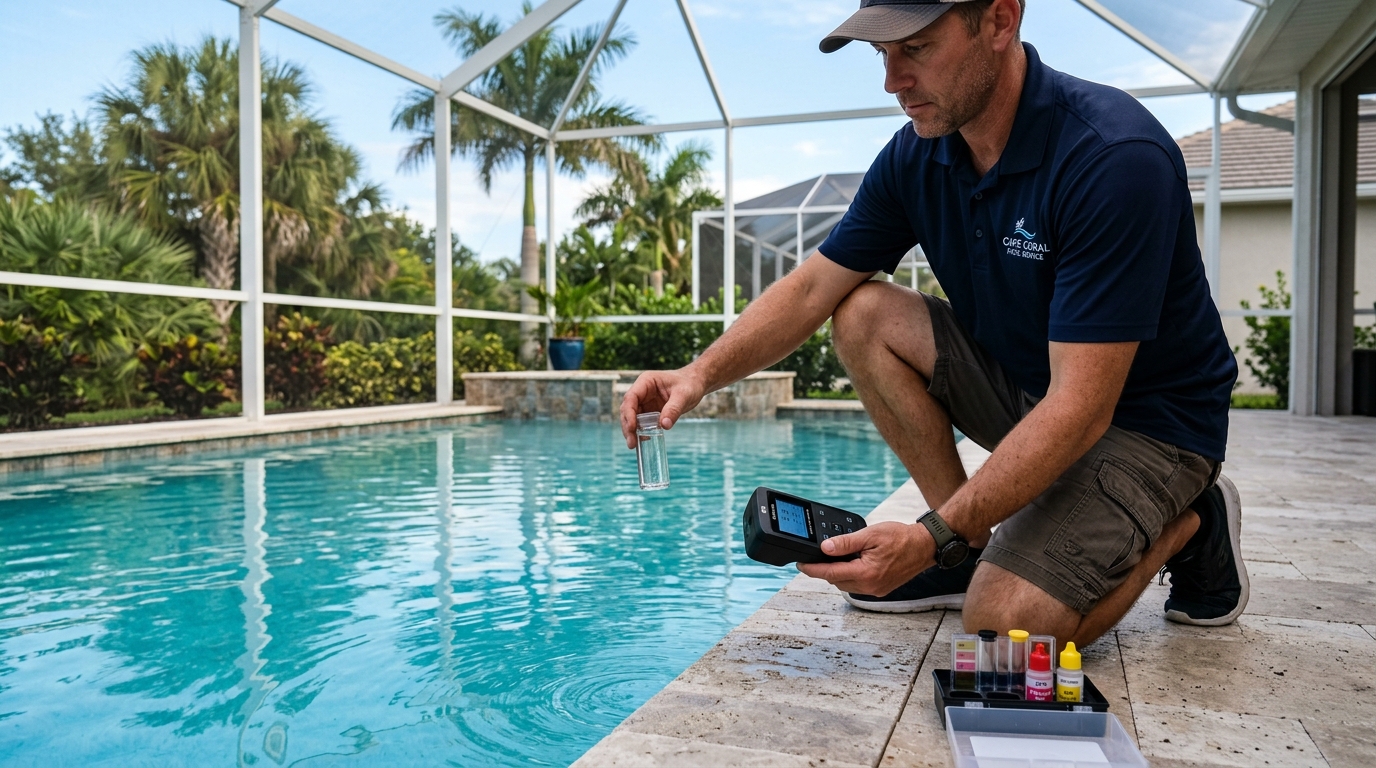
Water temperatures topping 92°F combined with daily subtropical downpours across Lee County create severe chemical volatility in residential pools. Homeowners in Cape Coral frequently observe test strips reading 5.0 ppm of total chlorine, yet mustard algae blooms rapidly along shaded steps and waterline grout. This condition signals chlorine lock induced by cyanuric acid saturation.
The Mechanics of Cyanuric Acid Saturation
Cyanuric acid (CYA), commonly sold as stabilizer or conditioner, acts as a chemical sunscreen that shields free chlorine molecules from photodegradation caused by intense Florida ultraviolet radiation. Without stabilizer, direct midday solar exposure degrades up to 90% of free available hypochlorous acid within two hours. Stabilizer molecules bond with free chlorine, protecting them from UV photons until pathogens require oxidation.
That protective mechanism reverses once stabilizer concentrations surpass 60 to 80 parts per million (ppm). As CYA climbs, the proportion of active, unbonded hypochlorous acid plunges below 1.5% of total residual chlorine. At 100 ppm CYA, maintaining water sanitation requires an active free chlorine reading of 7.5 to 10 ppm simply to duplicate the biocidal efficiency achieved by 2.0 ppm chlorine paired with 40 ppm CYA. Standard trichlor chlorine tablets comprise approximately 50% cyanuric acid by weight. For every ten pounds of trichlor dissolved into a typical 15,000-gallon Cape Coral pool, roughly 40 ppm of permanent stabilizer enters the water column.
Afternoon Storms and the False Dilution Myth
Many homeowners along Cape Coral’s canal network believe frequent tropical thunderstorms naturally dilute chemical build-up. While torrential rainfall adds surface volume, it concurrently introduces airborne orthophosphates, acidic organic tannins, and lawn nitrogen washed from surrounding pool cages. These contaminants instantly exhaust whatever free hypochlorous acid remains active in the basin.
Unlike chlorine, which evaporates into nitrogen gas as it oxidizes organic waste, cyanuric acid does not gas off. It neither breaks down under sunlight nor filters out through cartridge, sand, or diatomaceous earth media. The only physical method to reduce stabilizer concentration in a residential pool is mechanical drainage and controlled freshwater replenishment via our calibrated pool chemical balancing and routine weekly pool service protocols.
Shallow Water Table Risks and Partial Evacuation Protocols
Completely draining an inground swimming pool in Cape Coral involves serious structural hazards due to the city’s exceptionally shallow groundwater table. In low-elevation waterfront neighborhoods bordering canals, hydrostatic pressure from surrounding groundwater can lift an empty concrete or fiberglass shell right out of the soil, cracking underground plumbing and destroying deck structures.
Professional route coordinators avoid full drain-downs by employing sectional dilution cycles. Evacuating 30% to 40% of pool water volume from the deep-end main drain while actively adding fresh municipal water reduces CYA levels beneath the 50 ppm threshold without compromising vessel stability. Calibrated digital photometers verify that total dissolved solids (TDS) and calcium hardness remain within balanced LSI benchmarks before shock treatments resume.
Maintaining strict cyanuric acid thresholds between 30 and 50 ppm ensures active sanitizers destroy algae spores and bacteria consistently through the hottest summer months.