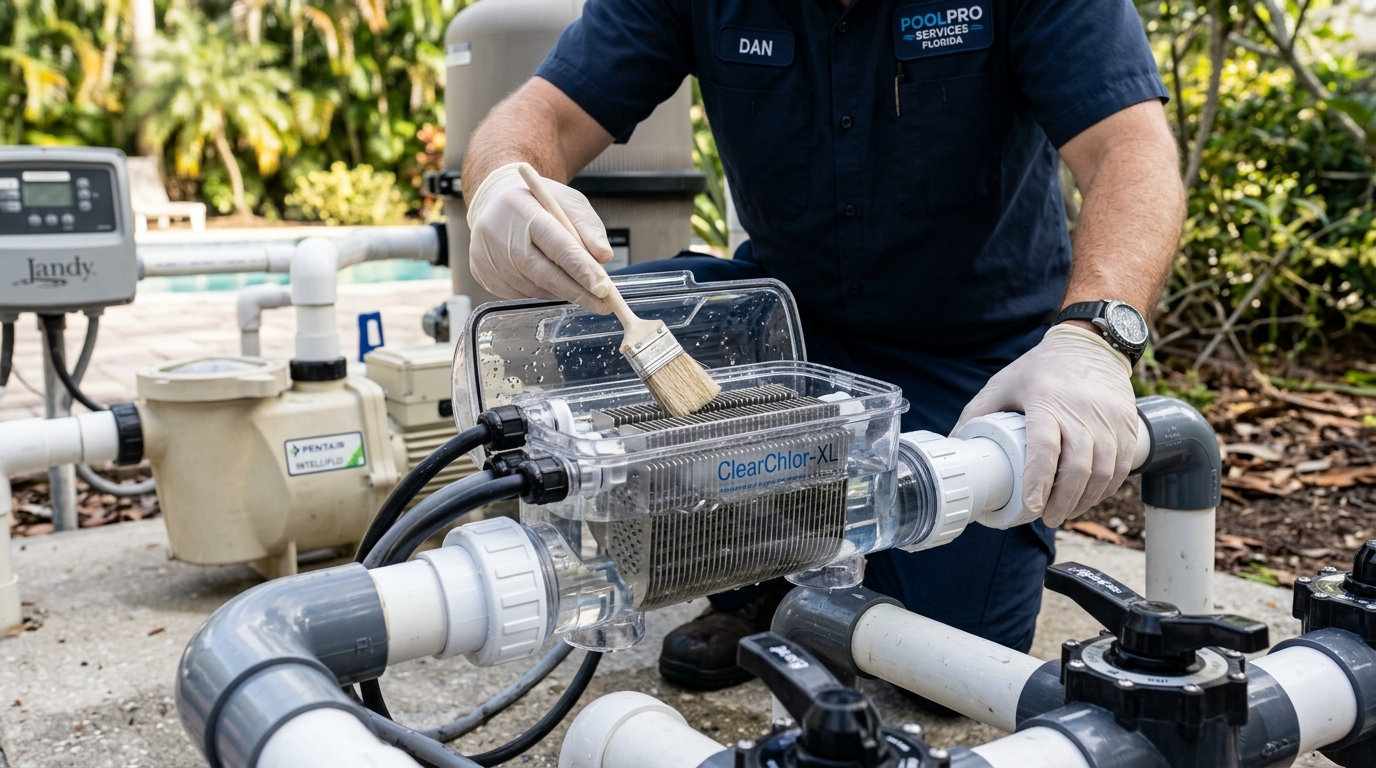
A sudden drop in chlorine generation accompanied by a flashing “Check Cell” alert on a Hayward, Pentair, or Jandy control center rarely indicates equipment failure. In Cape Coral, tap water drawn from mineral-dense municipal limestone aquifers causes calcium carbonate to crystallize across electrolytic titanium plates within four to six weeks of peak summer runtime.
The Chemistry of Electrolytic Calcification
Saltwater chlorination systems utilize low-voltage electrolysis to convert dissolved sodium chloride into pure sodium hypochlorite. As 24 to 30 volts of direct current pass across ruthenium-coated titanium plates, water molecules divide into hydrogen gas and hypochlorite ions. This electrolytic reaction generates localized heat and elevates the pH directly along cathode surfaces above 9.2.
Because municipal water in Lee County carries baseline calcium hardness ratings between 250 and 420 ppm, dissolved calcium carbonate precipitates out of solution almost immediately in this alkaline micro-climate. The mineral deposits form a dense white crust across the cell grid, acting as both an electrical and thermal insulator.
Performance Loss and Premature Plate Burnout
Operating a scaled electrolytic cell degrades chlorine output while stressing internal components. As scale bridges the narrow gaps between titanium plates, electrical resistance increases, driving the power transformer to overheat while chlorine output approaches zero. Homeowners often respond by cranking output settings to 100%, which accelerates electrical wear and strips the micron-thin ruthenium coating permanently.
Furthermore, mineral bridging disrupts internal salinity sensors. When false readings indicate insufficient salt levels, homeowners frequently dump unnecessary salt bags into the pool, corroding stainless steel handrails and pump seals. Maintaining your system with specialized saltwater pool service and regular pool pump repair checks prevents these costly diagnostics errors.
Standard 4:1 Muriatic Acid Descaling Protocol
Scraping scaled plates with metal screwdrivers or stiff brushes gouges the precious metal catalyst, permanently destroying chlorine generating efficiency. Professional descaling requires a controlled mild acid bath.
Route technicians mount the cell securely in a dedicated vertical cleaning stand and prepare a calibrated solution of four parts fresh water to one part 31.45% muriatic acid. Pouring acid into water—never water into acid—creates an effervescent reaction that dissolves calcium carbonate deposits within ten to fifteen minutes without harming the titanium blades. Technicians flush the cell with low-pressure hose water, inspect O-rings for elastomeric flexibility, apply food-grade silicone lubricant, and re-verify electrical amperage draw on the power center console.
Executing systematic quarterly inspections preserves the integrity of $1,100 electrolytic cells and ensures steady sanitizer production throughout Southwest Florida summers.